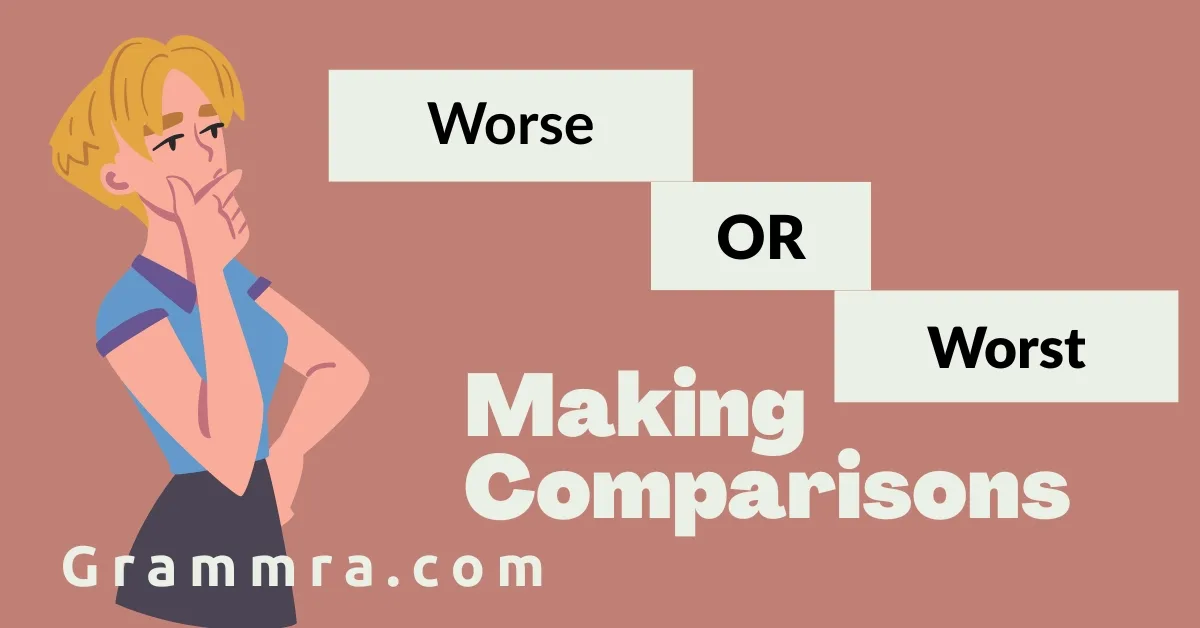
Have you ever stopped while writing and wondered, should I use “worse” or “worst”? You are not alone. These two words look almost the same, but they have different meanings and grammar rules.
Many English learners, students, and even native speakers mix them up because both describe something bad.
People often search for “worse or worst” because they want to write correctly in emails, school assignments, business reports, social media posts, and everyday conversations.
Using the wrong word can make your sentence sound awkward or incorrect. The good news is that the difference is simple once you understand one basic rule.
In this guide, you’ll learn the meaning of worse and worst, where the words came from, how British and American English use them, common mistakes to avoid, and many real-life examples. By the end, you’ll know exactly when to use each word with confidence.
Worse or Worst – Quick Answer
The difference is simple:
- Worse compares two things.
- Worst describes the lowest or most negative thing in a group of three or more.
Examples
✅ That was the worst mistake of my career.
Quick Rule
| Word | Meaning | Example |
| Worse | Comparative form of bad | This test is worse than the last one. |
| Worst | Superlative form of bad | This is the worst test this year. |
The Origin of Worse or Worst
The words worse and worst have existed in English for over a thousand years. They come from Old English.
- Worse comes from the Old English word wiersa.
- Worst comes from wierst.
Both words are forms of the adjective bad.
Unlike many adjectives that simply add -er and -est, the word bad changes completely.
Examples:
- Bad
- Worse
- Worst
This is called an irregular comparison.
The spelling has remained almost unchanged for centuries, so there are no spelling differences between British English and American English.
British English vs American English Spelling
Unlike words such as color/colour or center/centre, worse and worst have exactly the same spelling in both British and American English.
British English Examples
- The weather is getting worse.
- That was the worst holiday ever.
American English Examples
- Traffic is worse today.
- This is the worst game I’ve seen.
Comparison Table
| Feature | British English | American English |
| Worse | Worse | Worse |
| Worst | Worst | Worst |
| Meaning | Same | Same |
| Pronunciation | Nearly identical | Nearly identical |
| Grammar | Same | Same |
There are no regional spelling differences for these words.
Which Spelling Should You Use?
The answer is easy because there is only one correct spelling.
If your audience is in the United States
Use:
- Worse
- Worst
If your audience is in the United Kingdom
Use:
- Worse
- Worst
If your audience is in Australia, Canada, New Zealand, or other Commonwealth countries
Use:
- Worse
- Worst
For global audiences
These spellings are accepted everywhere English is used.
Common Mistakes with Worse or Worst
Many learners confuse these words.
Mistake 1
❌ This is worse movie ever.
✅ This is the worst movie ever.
Mistake 2
❌ Today is worst than yesterday.
✅ Today is worse than yesterday.
Mistake 3
❌ He is the worse player.
✅ He is the worst player.
Mistake 4
❌ This is the worse day of my life.
✅ This is the worst day of my life.
Mistake 5
❌ My cold is worst today.
✅ My cold is worse today.
Worse or Worst in Everyday Examples
Emails
“The internet connection became worse during the meeting.”
“This was the worst delay we have experienced.”
News
“Flood conditions became worse overnight.”
“It is the worst wildfire season in years.”
Social Media
“My phone battery keeps getting worse.”
“This is the worst pizza I have ever eaten!”
Formal Writing
“The patient’s condition became worse after surgery.”
“This represents the worst economic decline in a decade.”
Daily Conversation
“My back feels worse today.”
“That was the worst traffic jam ever.”
Worse or Worst – Google Trends & Usage Data
Search interest in worse or worst remains strong because many people want to understand the grammar difference.
Countries where people frequently search
- United States
- United Kingdom
- Canada
- Australia
- India
- Pakistan
- Philippines
Why people search
- Grammar homework
- English learning
- Writing emails
- School assignments
- Business communication
- Social media captions
- Job applications
The search phrase “worse or worst” is popular because learners want quick grammar help before writing.
Comparison Table
| Feature | Worse | Worst |
| Part of Speech | Comparative adjective | Superlative adjective |
| Used For | Comparing two things | Comparing three or more things |
| Base Word | Bad | Bad |
| Example | My cough is worse today. | This is the worst day ever. |
| Common Signal Word | Than | The |
| Correct? | Yes | Yes |
FAQs
Is it worse or worst?
Use worse when comparing two things. Use worst for the lowest or most negative item in a group.
Is “worse than” correct?
Yes.
Example:
“My score is worse than yours.”
Can I say “worst than”?
No.
Use worse than, not worst than.
Incorrect:
❌ Worst than yesterday.
Correct:
✅ Worse than yesterday.
Is “worst” always used with “the”?
Usually, yes.
Example:
“This is the worst day.”
However, informal speech may omit “the” in some expressions.
Is worse an adjective or adverb?
It can be both.
Adjective:
“The weather is worse.”
Adverb:
“He performed worse than before.”
Why are bad, worse, and worst irregular?
English inherited these forms from Old English instead of forming them with -er and -est.
Do British and American English spell them differently?
No.
Both varieties use the same spelling:
- Worse
- Worst
Conclusion
Knowing the difference between worse and worst is one of the easiest ways to improve your English. While the words look similar, they have different jobs.
Use worse when comparing two things. Use worst when talking about the lowest or most negative example in a larger group. Remember the simple pattern: bad, worse, worst. Since these forms are irregular, they do not follow the normal -er and -est spelling rules used by many adjectives.
Another helpful point is that British English and American English both use the same spelling, so you never have to change the word for different audiences.
Whether you are writing an email, posting on social media, preparing a school assignment, or creating professional content, choosing the correct word makes your writing clearer and more natural.
Whenever you are unsure, ask yourself one question: Am I comparing two things or choosing the most extreme one? That simple check will help you decide between worse and worst every time.

I am Adam Grant, an author at Grammra.com. I focus on creating educational content that helps readers improve their writing, grammar, and communication skills. My mission is to make language learning accessible and valuable for students, professionals, and lifelong learners.